When a Media Baron Becomes a Candidate
@onthemedia Pierre K Peladeau, Sun Media/Quebecor owner who's entered Quebec's April election–a bit like having Murdoch on a US ballot.
— Philip Turner (@philipsturner) March 14, 2014


@onthemedia Pierre K Peladeau, Sun Media/Quebecor owner who's entered Quebec's April election–a bit like having Murdoch on a US ballot.
— Philip Turner (@philipsturner) March 14, 2014
All TO mayoral wannabes attacking @OliviaChow shows she's a threat to 'em. Both bloviating Ford bros tried attacking her. #Weak #TOPoli
— Philip Turner (@philipsturner) March 12, 2014
Until reading this March 1 obituary by David Margolick about Lee Lorch I had not known about this brave man, or the vital role he played in ending racial bias in publicly-subsidized housing in New York City and the rest of the United States.
A WWII vet, Lorch came home from the war amid a nationwide housing shortage that was particularly severe in New York City. Then living with his wife Grace and daughter in what the NY Times reports Lorch called “‘half a Quonset hut’ overlooking Jamaican Bay in Queens,” he applied to live in the housing complex of Stuyvesant Town then being developed on the east side of Manhattan by Metropolitan Life Insurance Company with generous subsidies and accommodations from the city. He learned that African-Americans were explicitly barred from living in the development, as Met Life’s chairman Frederick Ecker told news media, “Negroes and whites don’t mix. If we brought them into this development, it would be to the detriment of the city, too, because it would depress all the surrounding property.” The Lorches and fellow tenants invited African-American families to come stay in there apartments as their guests, a move that drew Met Life’s ire and threats of eviction.
As a result, Lee Lorch lost his job teaching math at City College, and was made unwelcome at other universities where he applied to teach, including Penn State, which hired and then fired him in less than a year. For a time, he and his family were in Little Rock, Arkansas, where in 1957 Grace famously comforted Elizabeth Eckford, one of the “Little Rock Nine,” as she tried to attend Little Rock Central High School.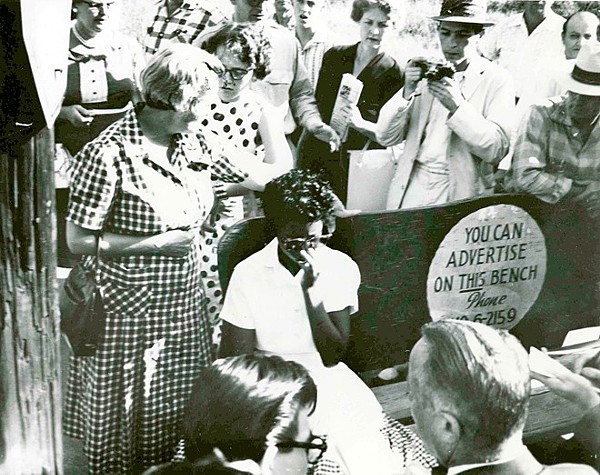
In addition, Lorch’s unapologetic membership in the American Communist Party caused civil rights leaders, including Thurgood Marshall, to keep their distance from him. After years of erratic employment in the States, in 1959 Lorch was offered a teaching position in Calgary, Alberta, Canada, and later York University in Toronto. The Lorches emigrated and much like young draft-age American males of the Vietnam era, the Lorches found a new home and haven north of the 49th Parallel.
Lorch lived a remarkable life, and one that should be remembered. In addition to the March 1 NY Times obit and a 2010 article, here are other Web resources:
1) Video with a 2010 interview of Lee Lorch
2) A segment with Lee Lorch’s daughter Alice from CBC’s As It Happens, remembering her father and the family’s life in Canada.
3) A review of David Margolick’s book Elizabeth and Hazel, on Elizabeth Eckford, of the Little Rock Nine, and Hazel Bryan, a white woman who yelled at her as she tried to enter Central High School in 1957.
4) An Arkansas Times Web feature with lots more information on the Little Rock Nine.
Cross-posted on my blog The Great Gray Bridge.
Photo: 1970, on a toboggan as my black Lab Noah looks on http://t.co/QUovtpU2aO
— Philip Turner (@philipsturner) February 26, 2014
The above picture with my dog Noah patiently waiting for me as I prepared to slide down a hill was taken during an outing for students of the School on Magnolia, the alternative high school I attended in Cleveland, Ohio in the early 1970s. In those days, my hair was sort of like that of NBA star Anderson Varejao, who plays for the Cleveland Cavaliers.  The second picture here was taken by my late brother Joel, in the living room of the home we grew up in, in the suburb of Shaker Heights, a few years after the wintry picture.
Seconds after winning the #OlympicHockey gold medal game, the Canadian Women's team charge the ice in jubilation. pic.twitter.com/hGkEZEAsql
— Philip Turner (@philipsturner) February 20, 2014

SATURDAY MORNING TV UPDATE: On Feb 15 the Sam Roberts Band will appear on CBS This Morning as part of their ‘Saturday Sessions’ series. According to press materials, they should go on at 8:45AM.
—-
Had a blast Tuesday night as the Sam Roberts Band of Montreal blew into town for one night to launch their terrific new album “Lo-Fantasy,” drawing a boisterous crowd to a sold-out Mercury Lounge. It was my first time hearing them live, after years of enjoying their music on CBC Radio 3. They are a tight rock n’ roll machine, starting with a tremendous rhythm section of of bassist James Hall and drummer Josh Trager, who played on a clear see-through kit allowing the audience to peer through the armature and really see him bashing away on the skins. I stood directly in front of Hall and Trager, and for the first half of the show I thought maybe that was why they sounded so good, then I decided, nah, they’re just great players. At center-stage was frontman Roberts, a small guy and a powerful rock n’ roll package–a handsome man and a lithe performer who bursts with vocal energy while striking insistent guitar chords, and moving around a lot on stage. On the far side of him from me were a keyboard player, lead guitarist, and saxophonist. The 6-piece outfit ripped through the 11 songs on the new album. Several I had heard already, like “We’re All In This Together”–with good lyrics expressive to me of a communitarian ethic. There’s an extended video of it below, and the process of making the new album. Once they worked through the new record, they took a bow and left the stage. It was clear though they’d be back for more. When they came back out for encores, they really gave the crowd full value, by playing another four songs, all from earlier albums. The sound was a mix of pure pop propulsion–most songs were uptempo, driven by the bass and drums–with Roberts’ vocals and strong riffs and tasty licks from the other three instrumentalists.
 Yesterday was Paperbag Records‘ official release date of “Lo-Fantasy.” They put out many of my fave Canadian bands, like Elliott Brood, Cuff the Duke and Rural Alberta Advantage. Sam Roberts is well known beyond Montreal and Canada, with the current tour taking him and his band to many US cities between now and March 28: Chicago; Grand Rapids, MI; St. Paul; San Francisco; San Diego; Seattle; Portland; Boston area; Washington, DC; and Philadelphia, where they’ll be playing World Cafe Live, a show that I’d bet will end up on public radio here in the States.
Just arrived in time for Heaven’s Jail, opening act for @samrobertsband sold out show tonite @MercuryLoungeNY. pic.twitter.com/vUg82m48Kd
— Philip Turner (@philipsturner) February 12, 2014
As good as Sam Roberts Band turned out to be, I also liked the opening act, Heaven’s Jail. I walked in as they started and was glad I had arrived on time. Love when that happens at a live show, walking in on the first notes to a new sound that’s immediately likable. Going to hear live music ought to be as much about discovering new bands as hearing longtime faves. Mercury Lounge did a smart thing booking them as the stage-setter for the evening. Based here in NYC, they’re a basic drums/bass/lead guitar trio, and so offered a clean sonic appetizer that went down real easy. For reference, their sound reminded me in the vocals of Warren Zevon, and in their bright jangling guitar-driven riffs they made think of the Felice Brothers from upstate New York who I heard open for Josh Ritter last year. Heaven’s Jail also have a current album, “Angelmakers,” which you can hear at their bandcamp page. I look forward to hearing them again.
After the Sam Roberts Band left the stage for the last time, a lot of the crowd melted away in to the cold NY night. I had already met some great people during the course of the long evening–like Emily Curran, a NYC schoolteacher who had seen Sam Roberts several times–so I stuck around, eager to meet other folks who’d enjoyed the evening, either from among the audience or the musicians. It being a release party it’s no surprise there were lots of music industry people on hand, like Ben Liemer of music distributor The Orchard who I really enjoyed talking with. Next I recognized two of the three members of Heaven’s Jail, and so chatted with them–Francesco and Ethan, guitarist and drummer. I complimented them on their set and we launched in to a spirited discussion of our rock n’ roll upbringings. I mentioned mine in Cleveland, and the great shows I was able to see in my early days as a live music fan, beginning with a Canned Heat and Cream bill back in the day. These conversations–plus one in a group with Sam Roberts’ brother Tom, who I learned lives in NY, and with his friend Jim, a bass player, capped off a fun night.
Via this link are more pictures from last night’s show, two black & white publicity shots of the Sam Roberts Band, and two videos of them performing.
Cross-posted at The Great Gray Bridge.
Loved Del Barber’s perf on @CBCRadioQ Friday. What great songs, recorded from inside old grain silos, farm structures, etc. @delbarberino
— Philip Turner (@philipsturner) February 9, 2014
 The few songs I’ve heard from Del Barber’s new album Prairieography–which on the video below he describes as a conscious homage to Ian Tyson’s 1987 album, Cowboyography–all sound great. I heard Barber live in 2011, at the much-missed Living Room venue, when he was included in a showcase put on by ManitobaMusic.com. He’s a tall lefthanded guitar player, and he held the room as a solo artist. The new album has a fuller sound, but still lean and acoustic. As he said on CBC Radio’s “Q” yesterday, he sought out old grain silos and abandoned farm buildings to record in. The songs sounded great live on the radio, but I’m equally eager to hear what they sound like on the album. In Shakey, Jimmy McDonough’s obsessively readable biography of Neil Young, I learned of Neil’s great interest in finding unusual places to record. Barber has the same passion for out of the way sound environments.

 Of course, Tyson began his career as half of Ian & Sylvia, but after they went their separate ways his career continued to grow. I don’t have “Cowboyography,” but I do own, and treasure his prodigious 19-song collection from 1994, “Old Corrals and Sagebrush & Other Cowboy Culture Classics.” Tyson’s so prolific that none of the songs from “Cowboyography,” two of which were co-written with the legendary Tom Russell, were included in the later anthology. Here’s a 5-minute video of Del Barber talking about the making of “Prairieography”–don’t miss his discussion of the grain silos and their reverb qualities at around the 2:11 mark.
Rob Ford is scheming to position himself as the champion of homophobe’s hopes, writes Edward Keenan in the Grid. He argues that the demoted mayor, with an eye cocked on next fall’s election, is trying to lock up the 20% of Toronto voters who are outright haters. With this in mind, it’s clear why he started the flap over the Pride flag yesterday, demanding it be lowered at City Hall, only minutes after it was hoisted in solidarity with those targeted in Sochi. As of now, it’s still flying, and despite Ford’s stunt, I don’t think it will be brought down. Toronto is one of many world cities linking hands with LGBT Russians and LGBT athletes. But Ford, knowing he’s lost with cosmopolitan-minded voters, is putting his heft behind discrimination.