Growing up in Cleveland, Ohio, a denizen of the Great Lakes region, I developed an affinity for Canada from my youth. My interest in the nation to the north was partly a function of proximity–from northeast Ohio, crossing Lake Erie to southern Ontario as a bird flies is only about a 40-mile span at its narrowest point. Aside from the geographical links I also found many cultural affinities I shared with the country. Already a radio listener, as a young teenager I regularly tuned my transistor to CKLW from Windsor, Ontario, a hit-making powerhouse just across the border from Detroit. After dark, its 50,000 watts wafted across Lake Erie to me as I lay in bed listening through a single earphone to the latest songs and the DJs’ patter. Meanwhile, to the east and north, Toronto was never more than a 4-hour drive away for Turner family vacations.
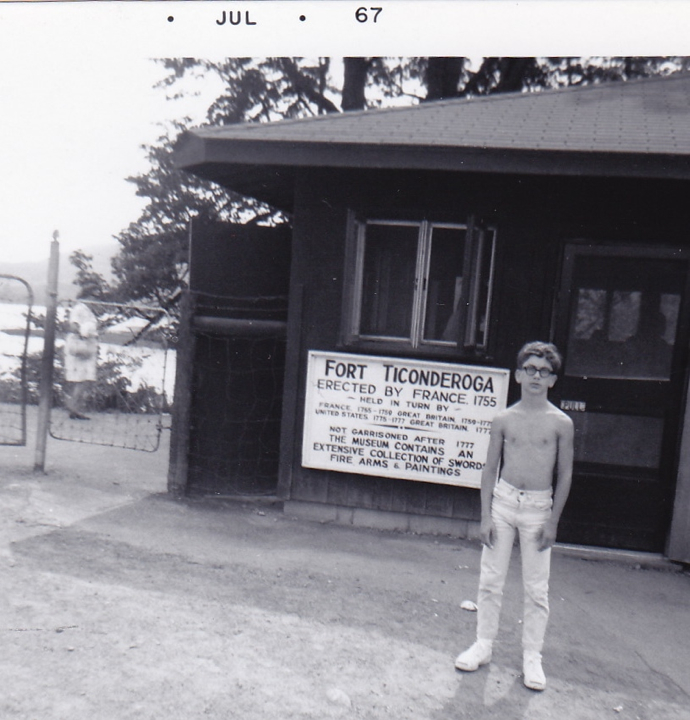
The summer before my thirteenth birthday I was studying Hebrew and preparing for my Bar Mitzvah that coming September. Taking note of the hard work I was putting in, my parents offered to take a summer road trip to a destination of my choice. It would be just the three of us, with my brother and sister staying with grandparents in Toledo. I told my mom Sylvia and dad Earl that I wanted to visit Montreal for Expo ’67, where the World’s Fair was being held that summer. It was only a two-day drive from home. In upstate New York, we toured Fort Ticonderoga, erected in 1755, a key point in the struggle between the British and French for control of the continent, and the then made an overnight stop in Burlington, Vermont. Once we reached Montreal, I marveled at the many geodesic domes dotting the cityscape, with Buckminster Fuller’s innovative designs making a big splash at the Expo. I enjoyed listening to the spoken French we heard in our motel, and the fact the urban scene clearly resembled other North American cities, yet was so different from Cleveland, the place I knew best. A few summers later, before I turned seventeen, my brother Joel was living in Olympia, Washington, attending Evergreen State College, and after a visit with him and our black Labrador Noah, I boarded a light plane for a flight from Aberdeen, WA, seated next to the pilot as his only passenger on the trip, soaring past the massive bulk of a mauve Mt. Rainier, then over the border to Vancouver, British Columbia, where I stayed one night in the Skid Row-ish neighborhood near the railroad station. The next morning I boarded a train for several days’ journey across the Canadian Rockies and the vast Laurentian Shield to Toronto, where I met my parents who had driven to meet me there for a few days’ visit.
In 1978, after attending Franconia College–an experimental institution located in the White Mountains of New Hampshire, less than two hours from Quebec–I began operating Undercover Books in Cleveland with the whole family (Joel, Sylvia, Earl, and sister Pam). We opened just as a new generation of Canadian authors was bursting in to print, and I took an instant liking to Canadian literature. As lead buyer, I figured out how we could order their books despite some trading barriers at the time. For instance, Bantam Books reserved a corner of their order form for an imprint called Seal Books, which I quickly figured out was a terrific source for Can-lit. Penguin also was great for Canadian authors, as can be seen in covers I’m sharing below. We introduced many Canadian authors to our customers including: Margaret Atwood, Mordecai Richler, Morley Callahan, Margaret Laurence, Marian Engel, Guy Vanderhaeghe, Morley Torgov, Timothy Findley, Farley Mowat, Pierre Berton, and the CBC broadcaster Patrick Watson, who visited our store to launch his 1979 suspense novel, Alter Ego, and Robertson Davies. In 1980s, we were routinely ordering Davies’ Deptford Trilogy (Fifth Business, Manticore, World of Wonders) by the carton, stacking the books up and selling them in great quantities. In my enthusiasm, at one point I wrote Davies a letter c/o of Penguin to let him know and introduce myself and tell him about our stores. He responded from Massey College in Toronto where he was Master, and a pleasant correspondence between us ensued, from which I’m glad I can reproduce his letters to me below. I recently wrote more about Davies when Canada Post marked the 100th anniversary of his birth with a new stamp. Here are pictures of a bunch of my editions of Canadian paperbacks we sold.
Over my seven years in the bookstore, from 1978-85, we introduced thousands of readers to books by Canadian authors. Our customers enjoyed them enormously and never seemed to balk at their Canadian-ness or find their settings off-puttingly unfamiliar. I began to see the literary world of the U.S.’s upper Midwest and Canada’s southern tier (and one might argue, the whole of the Pacific Northwest on both sides of the border) as contiguous literary cultures, different from but not really all that foreign one from the other.
Moving to New York City in 1985 to get started in publishing, I now found Canada’s east coast within driving reach for road trip vacations. On my own, I made three long excursions in my Renault station wagon, relishing the boarding of ferries whenever I could find them for marine passages, visiting Nova Scotia’s Cape Breton Island where I drove the Cabot Trail (which I consider the Big Sur of North America’s east coast), and toured the historic fortress of Louisbourg, the great atlantic port of 1700s Franco-America; Quebec’s Saguenay fjord and the nearby village of Tadoussac, with its grand red-shuttered, white clapboard hotel, and whales close by in the St. Lawrence; and the Gaspe Peninsula, including the monumental Perce Roche, or ‘pierced rock,’ a picture of which has given me the visual touchstone at the top of this blog, and which I wrote about here a few weeks ago. In 1988, after touring Nova Scotia a second time, I ferried from Sydney, on the northeast tip of Cape Breton, across to to the southern coast of Newfoundland, in late fall, during that year’s last week of crossings, before harsh weather would end the crossings for the season.
Driving up the province’s rugged west coast, I spent a weekend in the small city of Corner Brook, lodging in a family-run B&B. My hosts had the surname of Brake and I recall being served and enjoying the same food they were all eating themselves. The family patriarch Mr. Brake had on the Friday just prior been mandatorily retired from the national railway on account of his age, casting a funereal pall over their household. One afternoon he took his fiddle from its case, resined up the bow and began playing some traditional tunes, all the while telling stories of his years working on the railroad. As the only guest in their home, Mr. Brake explained in his distinctive accent that Newfoundland had twice by popular vote declined to join the federal union of Canada, only agreeing the third time, in 1949, when government ministers in Ottawa promised to build a Newfoundland leg of the Trans-Canada Highway, finally traversing the island province’s east-west bulk with a proper road. He added in sadness that for him, joining the federal union also meant that the provincial railway, for which he was already working prior to ’49, had also joined the federal system, decades later leaving him vulnerable to the age limit that had retired him that week at age 68, I recall.
Leaving the Brakes’ home, I ventured further north and camped in Gros Morne National Park, a UNESCO World Heritage site whose massive granite cliff walls tower two and three thousand feet above the Western Brook Pond. I’ve heard people call it the “Yosemite of Canada.” I really wanted to keep heading even farther north, to l’Anse aux Meadows, the place in North America where the Vikings landed, probably in the 1000s, leaving behind structures that were discovered in the 1960s. I imagine l’Anse aux Meadows is an archaeological cousin to Skara Brae, in Scotland’s Orkney Islands, a neolithic settlement from a Pictish or Viking habitation that I had visited earlier in the 1980s. But uneasy about making the last ferry back to the mainland of North America, I hightailed it back down Newfoundland’s west coast, catching a rough ferry ride back to Sydney on the second last day of the season.
In 1993, by then married to my wife, the artist Kyle Gallup, we made an autumn trip to Cape Breton. Near the major francophone ville of Cheticamp–hometown of the great Acadian fiddler Joseph Cormier, with whom my Franconia College pal Karl Petrovich had in the 1970s once played, swapping Cape Breton reels and waltzes. Kyle and I spent a few nights in a hamlet near Cheticamp called Petit Etang in a B&B with a local couple, Marie and Roland Doucet. Major League Baseball’s postseason was underway, and I was surprised to find that the Doucets were ardent baseball fans. I’d hardly expected to see baseball during this vacation, though the Toronto Blue Jays were competing that fall, and interest did extend to Atlantic Canada. The Doucets invited me to sit down and watch a Blue Jays vs. Phillies World Series game with them in their living room. On their mantle I saw what looked like a small shrine to Robert Clemente. When I asked Marie about the Clemente photo and figurine, she explained that he was a hero to them, owing to the humanitarian work he had been doing when he died in a 1972 plane crash, bringing relief supplies to earthquake victims in Nicaragua. Moreover, they’d later had a visiting priest in their parish from the Caribbean, a black man they admired greatly. They extended their positive feeling about Clemente toward other people of color from the Caribbean and baseball. After a few days in the Doucet household, we found a small house to rent in the nearby village of Margaree Harbour. When we left the Doucet home, Marie kindly packed us off with spaghetti sauce and fish chowder, so we “wouldn’t have to cook the first night” in our new abode, she told us.
We found the little house through a lucky visit we made to a local establishment called the Hungry Piper Gift Shop & Tea Room. Stopping in there for a look while we were still lodging at the Doucet’s B&B we met the shop’s proprietors, the May family, a clan with whom we became fast friends. They were John and Stephanie May, a married couple, and their grown son Geoffrey, married to Rebecca Lynne. They sold woolens, tartan ties, postcards, local crafts, and served light fare. We learned from Stephanie that they’d come from Connecticut originally, and that they’d moved north during the Vietnam War, lest Geoffrey be exposed to the military draft. John had held an executive position with an insurer in Hartford, while Stephanie was politically active, working for a nuclear freeze and on the McGovern for President campaign–alongside a young Arkansan named Bill Clinton, who about a year before this vacation of ours had become U.S. President. The Mays’ decision to move was also triggered after Stephanie discovered she’d been on Richard Nixon’s vaunted “enemies list.”
By 1993, the Mays were thoroughly ensconced in Margaree Harbour, running the shop which adjoined a docked schooner where Stephanie entertained many evenings playing piano and singing. On their property was another schooner, which upon close inspection I realized was “The Happy Adventure,” the very boat that Farley Mowat wrote about in his delightful book, The Boat Who Wouldn’t Float. The Mays knew Farley, and somehow had ended up with the broke-down vessel, which proved to be something of a tourist attraction for them. Stephanie and John had one other child, a grown daughter named Elizabeth who was a director of Sierra Club Canada, living in a distant city. She owned a little house in Margaree Harbour, not then in use, and the Mays suggested we could rent it during our stay in the area. Kyle and I took them up on it, and with a spirit of adventure undimmed by the fact the house had little heat and hot water, we loved our time there. I had a portable radio with me, and so got to hear the Blue Jays win the World Series, when Joe Carter hit his walk-off come-from-behind homer in Game 6.
A couple nights later we joined Geoffrey and Rebecca Lynne at their house for dinner. This happened to be the day of a Canadian federal election, and Geoffrey also invited us to stick around and watch election returns with them. It turned out to be an amazing night, as this was the election in which the federal tories were entirely swept out of power in one of the most lopsided defeats ever in the history of modern elections. It was a jubilant evening–for comparison’s sake, imagine all Republican officeholders in the U.S. losing on the same day. Our distant landlord for that week, Elizabeth May, would later became a prominent Canadian politician, chair of Canada’s Green Party, and the first Green Party member of Parliament.
All these great trips made majestic Canadian scenery and warm Canadian people an indelible part of my mental and emotional landscape.
As an editor and publisher, I consciously broadened my efforts to introduce Canadian culture to American readers, bringing out U.S. editions of books by Atwood, Richler, Mowat, Berton, and Lt. General Romeo Dallaire, as well as Paul Quarrington, Antonine Maillet, Ken McGoogan, Julian Sher, William Marsden, Elaine Dewar, Bonnie Buxton, Howard Engel, Joan Barfoot, George Eliot Clarke, Steven Galloway, Joel Hynes, Paul Anderson, Sheila Munro, Jan Lars Jensen, and others.
In 2009 I discovered Canada’s thriving indie music scene, which quickly became a new passion of mine. I found the music instantly likable, enjoying the recorded output of hundreds of talented artists including such acts as Dan Mangan, Rose Cousins, Cuff the Duke, Imaginary Cities, Wintersleep, Chic Gamine, Said the Whale, and Elliott Brood. I became a member of CBC Radio 3‘s informal community, an Internet radio station where I comment regularly on the in-house blog and have become friendly with dozens of fans of this music from all over North America, with the station hosts, and with Canadian musicians, regularly attending their live shows at NYC venues when they come through town. With New Jersey friend Steve Conte, another Radio 3 fan, we created a Twitter hashtag to promote these shows, #R3NYNJ. In 2011 I began attending Toronto’s annual North By Northeast (NXNE) Festival, the last two years for my blogs as accredited press. At NXNE in June 2013, I heard more than 30 bands over four days, posting about the shows here, here, here, and here, and look forward to attending again this year, now writing for two blogs, this one, and my original site, The Great Gray Bridge.
A couple last points about Canada and the USA. I know there are many good musical acts and authors who are not Canadian, and I am under no illusion that Canada is a perfect society, or that its politics aren’t tainted by some of the same anti-democratic impulses as politics in the U.S. Despite my affection and respect, I’m aware that Canada’s story includes many historical injustices and contemporary flaws. And yet, Canada has always struck me as having insanities and obsessions that are a step or two less insane and obsessive than those of my homeland. For that I am grateful, even while not idealizing Canada.